
SABM AI in Patient Blood Management Research Award
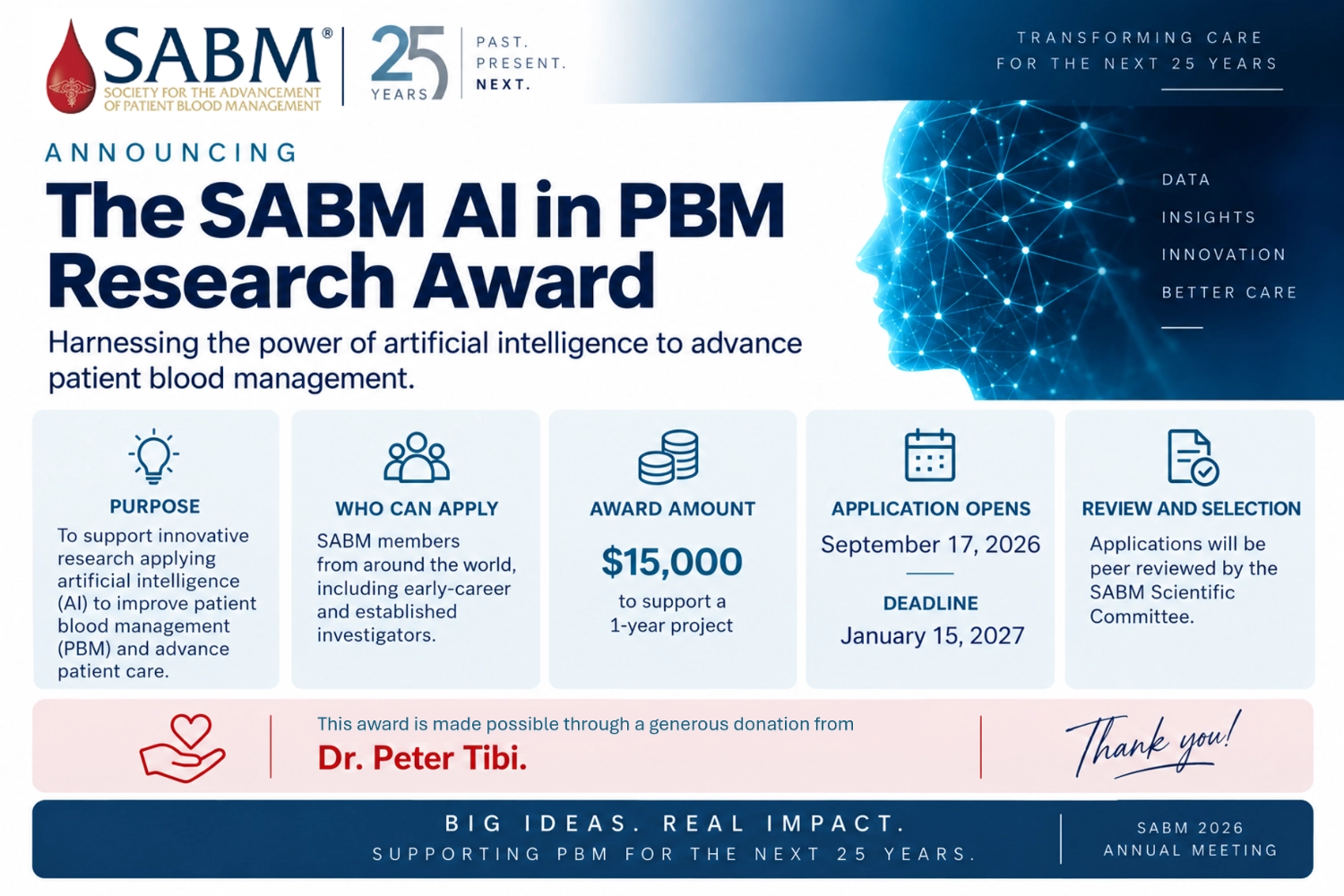
Inaugural Award: 2027 SABM AI in Patient Blood Management Research Award
Award amount: Up to $15,000
Project period: Up to 12 months
Application deadline: January 15, 2027
Anticipated award notification: February 15, 2027
Anticipated start date: April 1, 2027
1. Purpose
The Society for the Advancement of Patient Blood Management (SABM) invites applications for the SABM AI in Patient Blood Management Research Award.
This grant will support an innovative research project examining the responsible use of artificial intelligence to advance patient blood management. The program is intended to generate practical knowledge, preliminary evidence, or tools that may improve PBM-related clinical care, education, implementation, or decision-making.
SABM anticipates making one award of up to $15,000 for a project lasting no more than 12 months.
2. Background
Artificial intelligence offers emerging opportunities to support patient blood management across the continuum of care. Potential applications include risk prediction, clinical decision support, identification and management of anemia, transfusion utilization, blood-loss mitigation, outcome measurement, education, workflow improvement, and dissemination of PBM practices.
At the same time, the use of AI in healthcare presents important questions involving clinical validity, transparency, bias, privacy, human oversight, implementation, and patient safety.
Through this grant, SABM seeks to encourage rigorous, responsible, and clinically meaningful investigation at the intersection of artificial intelligence and patient blood management.
3. Areas of Interest
Applications may address topics including, but not limited to:
- AI-supported identification, evaluation, or treatment of preoperative or hospital-acquired anemia;
- Prediction of transfusion risk, bleeding risk, or PBM-related clinical outcomes;
- Clinical decision support intended to reduce avoidable transfusion or improve appropriate blood-product utilization;
- Natural-language processing or machine-learning approaches for identifying PBM opportunities in clinical records;
- AI-assisted measurement, benchmarking, auditing, or reporting of PBM performance;
- AI applications supporting blood-loss prevention, coagulation management, or patient-centered decision-making;
- AI-enabled PBM education for clinicians, trainees, patients, or healthcare organizations;
- Evaluation of bias, equity, safety, explainability, privacy, or ethical considerations in AI-enabled PBM;
- Implementation research examining adoption of AI tools in PBM workflows;
- Development or validation of an early-stage AI-related PBM method, model, dataset, framework, or prototype.
Projects must have a clear connection to patient blood management. Applications focused primarily on general artificial intelligence, transfusion medicine, blood banking, or healthcare operations without a meaningful PBM component will not be considered responsive.
4. Types of Projects Supported
The grant may support:
- Pilot or feasibility studies;
- Retrospective or prospective observational studies;
- Secondary data analyses;
- Quality-improvement research with broader learning objectives;
- Implementation or evaluation studies;
- Model-development or validation projects;
- Educational research;
- Development and preliminary testing of a prototype, framework, or tool;
- Systematic or scoping reviews when they address a clearly defined knowledge gap and include a plan for meaningful dissemination.
The proposed project should be achievable within the available budget and 12-month project period. Applicants are encouraged to propose focused projects capable of producing a defined scholarly or practical deliverable.
5. Eligibility
The principal investigator must:
- Be an active member of SABM at the time of application
- Be a clinician, researcher, educator, data scientist, implementation specialist, trainee, or other professional working in an area relevant to patient blood management;
- Hold an appointment or formal affiliation with an eligible healthcare, academic, research, or nonprofit institution capable of accepting and administering the award;
- Demonstrate access to the expertise, data, technology, facilities, or collaborators necessary to complete the proposed work; and
- Agree to comply with applicable institutional, ethical, privacy, data-security, and regulatory requirements.
Multidisciplinary applications are strongly encouraged. Teams may include expertise in PBM, clinical medicine, nursing, transfusion medicine, anesthesiology, surgery, hematology, informatics, computer science, data science, implementation science, education, ethics, health equity, or related disciplines.
Individuals directly involved in administering or selecting recipients for this grant may not apply. Additional conflict-of-interest restrictions may be imposed as appropriate.
6. Award Terms and Allowable Costs
One award of up to $15,000 is anticipated.
The award amount is inclusive of all direct and indirect costs. Institutional indirect costs may not exceed 10% of allowable direct costs and must be included within the maximum award amount.
Allowable expenses may include:
- Research personnel or analyst effort;
- Statistical, informatics, programming, or data-management support;
- Data acquisition or access fees;
- Software, cloud-computing, or secure data-storage costs attributable to the project;
- Participant-related costs;
- Limited supplies or equipment necessary to complete the project;
- Research-assistant or trainee support;
- Publication or dissemination expenses;
- Other project-specific expenses that are reasonable, justified, and directly related to the proposed work.
Funds may not be used for:
- General departmental or institutional operations;
- Major capital equipment;
- Clinical care that would ordinarily be billed to a patient or payer;
- Salary support unrelated to the proposed project;
- Commercial product development undertaken primarily for private benefit;
- Lobbying or political activity;
- Entertainment, gifts, or alcohol;
- International travel unless specifically approved in advance;
- Costs incurred before the official project start date; or
- Expenses prohibited by SABM policy or applicable law.
Budget revisions affecting the project’s scope or reallocating more than 25% between major budget categories require prior written approval from SABM.
7. Application Requirements
Applications must be submitted as a single PDF and include the following sections.
A. Cover Page
Include:
- Project title;
- Principal investigator’s name, credentials, title, institution, and contact information;
- Names, credentials, roles, and institutions of key team members;
- SABM membership status;
- Total amount requested; and
- Proposed project dates.
B. Project Summary
Provide a summary of no more than 300 words describing the problem, proposed approach, anticipated results, and relevance to patient blood management.
C. Research Plan
The research plan may not exceed four pages, excluding references, and must include:
- Problem and significance
Describe the problem being addressed, the relevant evidence or practice gap, and its importance to PBM. - Specific aims or objectives
State the project’s principal research question, aims, or evaluation objectives. - Methods
Describe the project design, setting, population or data source, AI-related methods, comparators where applicable, outcomes, analytic approach, and anticipated limitations. - Responsible AI considerations
Address the project’s approach to clinical oversight, validity, bias, equity, explainability, privacy, data security, and patient safety, as applicable. - Feasibility and timeline
Explain why the project can be completed within 12 months and provide key milestones. - Expected products and impact
Identify the expected findings, tool, framework, publication, presentation, educational resource, or other deliverable and explain how it could advance PBM.
D. Team and Environment
In no more than one page, describe the qualifications of the project team, the institutional environment, available resources, and relevant collaborations.
E. Budget and Justification
Provide an itemized budget and a concise justification for each expense. The total request, including institutional indirect costs, may not exceed $15,000.
F. Biographical Information
Include a curriculum vitae, biosketch, or résumé of no more than five pages for the principal investigator and each key collaborator. The NIH biosketch framework is preferred.
G. Other Support and Related Funding
Disclose current or pending support relevant to the proposed project. Applicants must identify any financial, advisory, employment, intellectual-property, or other relationships that could reasonably be perceived as related to the proposed research or AI technology under evaluation.
H. Institutional Confirmation
Provide a letter from an authorized institutional representative confirming that the institution is willing to accept and administer the award. A final institutional signature and grant agreement will be required before funds are released.
8. Regulatory and Ethical Requirements
Awardees are responsible for obtaining all required institutional approvals before beginning the relevant activities, including institutional review board, privacy, information-security, data-use, animal-care, or other approvals as applicable.
Human-subjects research may not begin, and SABM funds may not be used for such activities, until the recipient has provided SABM with documentation of required approval or a formal determination that review is not required.
Projects involving protected health information, identifiable data, external AI platforms, or cloud-based processing must comply with applicable laws and institutional privacy and security requirements.
SABM funding does not constitute regulatory, clinical, ethical, privacy, or information-security approval of the proposed technology or methodology.
9. Review Criteria
Applications will be evaluated using the following criteria:
Significance and relevance — 25%
- Importance of the problem;
- Relevance to patient blood management;
- Potential to improve knowledge, education, implementation, or patient care.
Scientific and technical approach — 25%
- Clarity of the aims;
- Appropriateness and rigor of the methods;
- Quality of the proposed analysis or evaluation;
- Recognition of limitations.
Innovation — 20%
- Originality of the question or approach;
- Appropriate and meaningful use of AI;
- Potential to generate new insight, capability, or application.
Responsible AI and safeguards — 10%
- Attention to validity, bias, equity, privacy, transparency, human oversight, and safety;
- Appropriateness of data governance and institutional controls.
Feasibility — 10%
- Qualifications of the team;
- Access to required data, expertise, and infrastructure;
- Likelihood of completion within the proposed period and budget.
Dissemination and future potential — 10%
- Quality of the proposed deliverables and dissemination plan;
- Potential to inform broader research, education, practice, or future funding.
Preference may be given to projects that are multidisciplinary, generate practical learning for the PBM community, support early-stage investigators, or establish a foundation for larger externally funded work.
10. Selection Process and Conflicts of Interest
Applications will be reviewed by individuals selected by SABM for their relevant scientific, clinical, methodological, and PBM expertise.
Reviewers must disclose actual or potential conflicts of interest and will be recused from evaluating applications where a conflict exists.
SABM reserves the right not to make an award if no application is judged sufficiently responsive, rigorous, feasible, or aligned with the program’s purpose.
All funding decisions are final.
11. Award Administration and Payment
The award will be made to the recipient’s eligible institution rather than directly to an individual investigator.
Before payment, the recipient institution and principal investigator must execute a grant agreement addressing:
- Approved scope of work and budget;
- Project schedule and milestones;
- Required institutional and regulatory approvals;
- Financial and progress reporting;
- Conflicts of interest;
- Data stewardship, privacy, and security;
- Use of SABM’s name and acknowledgment of support;
- Intellectual property;
- publication and dissemination;
- unspent funds;
- suspension or termination; and
- other applicable terms.
SABM anticipates disbursing the award as follows:
- 100% upon execution of the grant agreement and confirmation of required approvals
SABM may modify the payment schedule based on the recipient institution’s requirements or the nature of the project.
Unused or improperly used funds must be returned to SABM.
12. Deliverables
The awardee must provide:
- A brief interim narrative and financial report at approximately six months (1 page);
- A final narrative and financial report within 60 days after the project period;
- A concise, nontechnical summary suitable for SABM communications;
- A presentation, webinar, poster, abstract, article, toolkit, educational resource, or comparable dissemination product; and
- A final presentation of results to the SABM community, if requested by SABM leadership.
The recipient should notify SABM of publications, presentations, subsequent funding, implemented tools, or other outcomes arising from the project for at least two years following the award.
13. Publication, Independence, and Acknowledgment
Investigators will retain responsibility for the design, conduct, analysis, interpretation, and reporting of their work.
SABM may not suppress or direct research findings. The recipient must be free to publish results regardless of whether they are favorable, unfavorable, or inconclusive, subject to reasonable review periods for confidential information, privacy, and intellectual-property protection.
Publications and presentations resulting from the award must acknowledge support using the following language:
This work was supported by the Society for the Advancement of Patient Blood Management (SABM) AI in Patient Blood Management Research Grant, made possible through a charitable contribution from Dr. Peter Tibi, MD.
Any publication or presentation should state that the findings and conclusions are those of the authors and do not necessarily represent the views of SABM.
Use of SABM’s name, logo, or endorsement in connection with a commercial product requires prior written authorization.
14. Intellectual Property
Intellectual property created through the project will ordinarily remain with the recipient institution and investigators, subject to their institutional policies and the final grant agreement.
SABM should receive a nonexclusive, royalty-free right to use and share nonconfidential project summaries, reports, educational materials, and other agreed deliverables for its charitable and educational purposes.
Applicants must disclose any existing intellectual property, commercial relationship, proprietary AI platform, or anticipated licensing interest that may affect the project.
15. Application Submission
Click “Submit Now” button below.
Applications must be received by 11:59PM Eastern Time on January 15, 2027
Questions may be directed to: info@sabm.org
Late, incomplete, or nonresponsive applications may not be reviewed.
16. Anticipated Timeline
| Milestone | Date |
|---|---|
| RFA released | 09/17/2026 |
| Application deadline | 1/15/2027 |
| Scientific and programmatic review | 1/15/2027 – 2/15/2027 |
| Award notification | 2/15/2027 |
| Grant agreement completed | 3/15/2027 |
| Project begins | 4/1/2027 |
| Interim report due | 9/1/2027 |
| Project concludes | 1/31/2028 |
| Final report due | 3/31/2028 |
About SABM
The Society for the Advancement of Patient Blood Management is a multidisciplinary professional organization dedicated to improving patient outcomes through the advancement and implementation of patient blood management. Through education, collaboration, research, and advocacy, SABM supports healthcare professionals and institutions working to advance evidence-based PBM practices.
This RFA is subject to revision. Issuance of the RFA does not obligate SABM to make an award or reimburse applicants for the costs of preparing an application.

This award was made possible through the generosity of Dr. Peter Tibi – cardiac surgeon, tireless patient blood management advocate, and former SABM President, Board Member, and Founder.