

Patient Blood Management (PBM): A Strategic Imperative for Healthcare Leadership
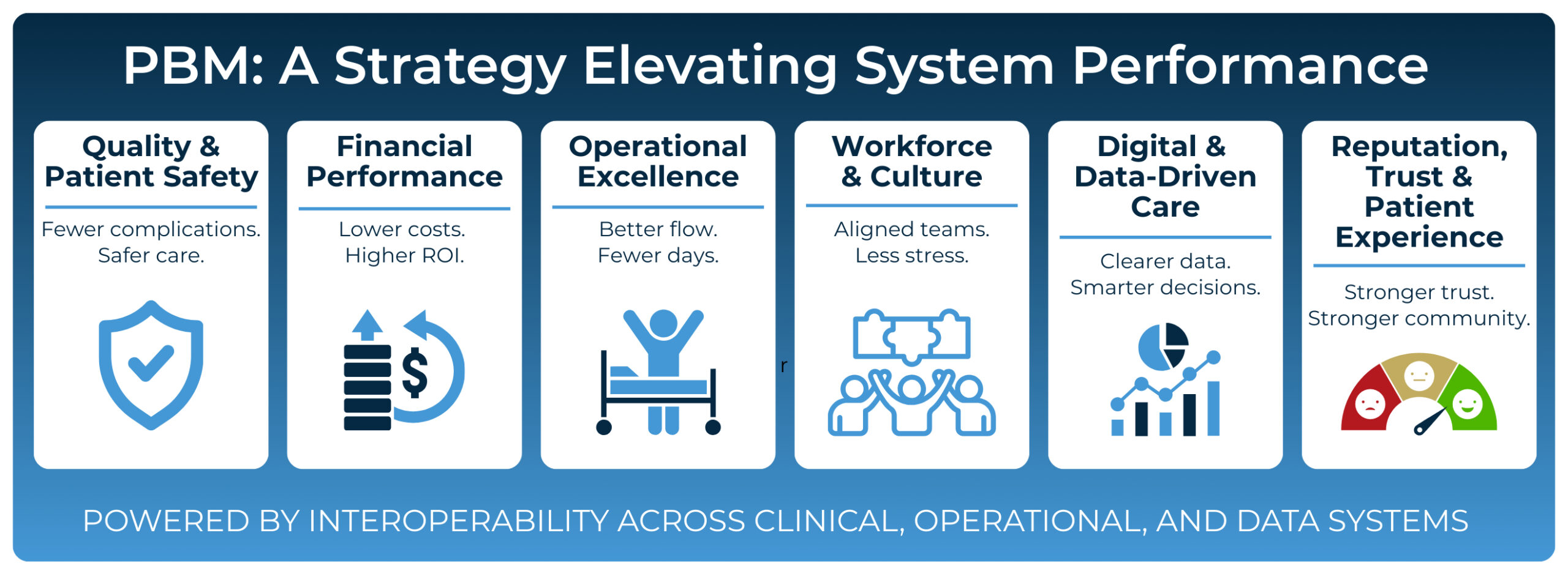
Patient Blood Management (PBM) is a high-value, system-wide strategy that strengthens both clinical and financial performance. PBM improves patient outcomes and operational reliability while enabling the development of evidence-based, revenue-generating clinical services (e.g., preoperative anemia services, inpatient consultation services, IV iron therapy) alongside meaningful reductions in transfusion-related costs and complications.
Across diverse health systems, PBM consistently delivers 20–40% reductions in transfusion use, shorter lengths of stay, fewer major complications, and returns on investment reported up to 7:1 allowing organizations to improve care and grow value without new beds or major capital investment.
Use this section to explore PBM from a healthcare executive perspective, access expert insights, review strategic evidence, and connect with the tools your teams need to implement PBM successfully.
Start here: The Executive Case: Why Blood Health Matters
Table of Contents
PBM Value Proposition
- The Executive Case: Why Blood Health Matters
- PBM Alignment with Competitive Strategy
- The Financial Imperative: ROI
- Strategic and Clinical Foundations of PBM
- Proven Outcomes & Case Studies
Implementation Playbook
- Governance & Leadership Structure
- Data, Metrics & Analytics
- FAQs
- SABM Executive Guide, 3rd Edition – Full PBM Playbook
- SABM PBM Standards
- SABM Leadership Briefing Deck
Partner & Learn
What Executives Are Saying About PBM
PBM has “the ability to turn over beds, which turns new patients, which allows for new patients to come in, which increases revenue.
From an operational perspective, it improves patient outcomes, quality, and patient satisfaction.
From a strategic planning perspective, it really creates a niche in the marketplace.”
“For our 800-bed hospital, the savings were approximately $1.5M a year just on platelets and blood.“
“By implementing PBM protocols across the enterprise, there is less likelihood of transferring a patient away because they can’t do the case or delaying a surgery until blood arrives. So it’s a much better approach in the operating room for patient care.”
“Blood is an organ. When a patient needs to have a blood transfusion, we are actually giving them an organ transplant.”
“There were several areas where PBM either increased revenue or decreased costs. The blood product decrease in usage certainly saved costs. The reduction in length of stay saves costs and turns the bed so that a new patient could come in, especially if it’s a high demand service. And the third way was attracting new patients who were interested in either not getting a blood transfusion or we’re attracted by the fact that outcomes and quality increased as a result of PBM being implemented across the organization.”
“If blood transfusions need to occur, that is going to increase length of stay, therefore you’re going to have a patient in the hospital longer which is going to impact capacity, which therefore will cost the hospital more.”
Exec Corner Sponsor
This project was made possible through the generous support of Johnson & Johnson MedTech.

Related Resources
Disclaimer
The Society for the Advancement of Patient Blood Management (SABM) and the educational websites Iron Corner, Coag Corner, and Exec Corner do not provide medical advice. The content of these websites is intended for general informational purposes only and does not address individual circumstances. The information is not intended as a substitute for medical or legal advice, diagnosis or treatment, and its content should not be relied upon to make medical health decisions or for any other medical or legal purposes. Readers should never ignore medical advice in seeking treatment because of something they have read in the SABM website, Iron Corner, Coag Corner, or Exec Corner. Readers should make their own determinations as to: (i) what constitutes appropriate medical, technical, and administrative practices, and (ii) how best to evaluate and utilize for medical purposes any content posted in the SABM website, Iron Corner, Coag Corner, or Exec Corner educational resources and (iii) how best to comply with laws and regulations relevant to any questions. For the latter, readers should consider consulting, as to any medical matters, a qualified physician, and, as to any legal matters, an attorney familiar with related state and federal laws. The user of the SABM website, Iron Corner, Coag Corner, or Exec Corner, by accessing same, assumes all risks arising out of such use and releases SABM and its respective members, directors, officers and agents from and against any loss, damage, claim or liability arising out of such use of the SABM website, Iron Corner, Coag Corner, or Exec Corner. The SABM, Iron Corner, Coag Corner, and Exec Corner websites are based in the United States and the content herein as based on information (including, for instance, information and data pertaining to lab indices, pharmaceutical products and treatment protocols) pertaining to the United States for users in the United States. Additionally, information in this website pertaining to typical private and government insurance reimbursement issues may vary from one region of the United States to another. This site also contains “off label” information. Users of this website should be guided accordingly.